Wednesday, January 6, 2010

Poem.

Class started on Monday. I returned from my trip on Tuesday. Now, I play catch up, during which I still intend to post stories and thoughts from our 11-day cross-country trip.

This thought comes from the New Orleans' riverfront. We encountered the city after a long drive in Texas, so we decided to stop and explore the Vieux Carré. Though we had seen the Mississippi river twice before during our trip, they were always from the confines of our car. That day marked my first acquaintance with the grand river, which made me think of a beloved Langston Hughes poem:

The Negro Speaks of Rivers

I've known rivers:
I've known rivers ancient as the world and older than the
flow of human blood in human veins.

My soul has grown deep like the rivers.

I bathed in the Euphrates when dawns were young.
I built my hut near the Congo and it lulled me to sleep.
I looked upon the Nile and raised the pyramids above it.
I heard the singing of the Mississippi when Abe Lincoln
went down to New Orleans, and I've seen its muddy
bosom turn all golden in the sunset.

I've known rivers:
Ancient, dusky rivers.

My soul has grown deep like the rivers.


Powerful, eh? I highly recommend listening to Hughes read the poem himself here. He also describes what led him to write 'The Negro Speaks of Rivers.'


OK. back to anatomy. More on that subject later.

Sunday, January 3, 2010

Rêve

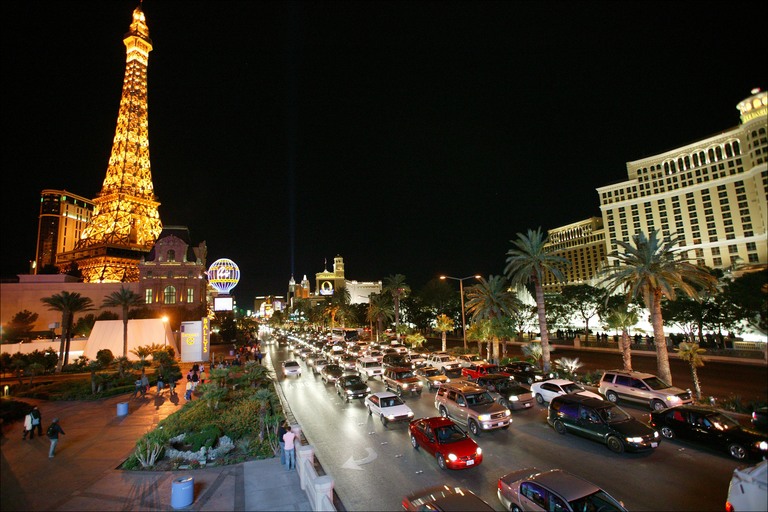
Our road trip continues. We encounter Las Vegas. If it were a book, it would be a combination of a sci-fi and a fantasy novel. I’ve visited the city last December and experienced the renowned “Strip” (Las Vegas Boulevard) for a second time.


I love the city – not because I like to gamble or shop, but because I like to observe. Next time you visit, notice how each resort, restaurant, store tries to lure you into their depths. Posters of show girls, comedians, even Donnie and Marie cover whole buildings. Pedestrian bridges, thought for safe travel down the strip, merely guide you directly into the next casino or mall. One casino had an escalator into the building without an escalator leading out. Some hotels offer free parking (!!!), yet after parking they take you through the casino to access the street – more temptations to gamble. Hey, you get what you pay for.

Once you’re inside one of the casinos (its unavoidable), look up. The ceiling always looks miraculous with mirrors, fancy gold trim, chandeliers, etc. In Paris, they paint fluffy, bright, French clouds that stay bright for 24 hours. You can gamble your money away at 4am and still think it’s 4pm if you wanted to. Look closely and you’ll see vents that supply oxygen to keep the gamblers energized.

This, my friends, is pure genius. Viva Las Vegas! On with the trip!

Wednesday, December 30, 2009

Transamerica

In my study of US history, I considered the periods between the Civil War (1860’s) and the turn of twentieth century quite boring. People lived. Died. Stuff happened. That’s it. However, one event stands out in my mind.


In 1869, Irish and Chinese immigrants completed the transcontinental railroad, sparking the end of the western frontier – a once unthinkable accomplishment. Before this railroad existed, only horses, ponies, and oxen had the capabilities to go from the Mississippi to the Pacific.

Did you want mail delivered to San Francisco from St. Louis? Take it on the pony express. Want to move to Oregon to start a farm? Get some oxen for your covered wagon and be prepared to climb mountains, ford streams, and risk starvation and disease to get to your destination.

The transcontinental railroad signified a historical shift not only in how Americans travel, but also how we view the mysteries of The West.

As we trek I-80 from Michigan to San Francisco in the comfort of our Pontiac Vibe, I think how different things are now – only 140 years later. Now, we can trek the Rockies on a paved, national highway system at 75 miles per hour with ease. You can also swim in an indoor pool, watch HBO, eat McDonalds, and see the latest movie if you wish. Times have changed – no cholera or hay fever, no buffalo (because we killed them all), and no threats of “Indian attack” – we gave the Native Americans too many other problems to deal with.

Interestingly, the route of the original transcontinental railroad closely matches that of Interstate 80.

As I type this sentence on my macbook, we spend our first moments in Wyoming together - at 70 miles an hour. How rugged.

I will keep you posted for more news.

Saturday, December 26, 2009

MD/8

...so I completed my first semester of medical school and can consider myself to be .125MD or one-eighth of an MD – that means if you come to me with eight diseases, I can only treat one of them. As I emerge from my medical cave into society, people often ask me the "how did it go?" question, which always catches me off guard. (“err… ok, I guess?” “It’s over.” “I didn’t die from studying too hard.”). Frankly, the semester went by in a blur. It flew from August to December, and I barely remember what happened in between.

For winter break, I emerged from my medical cave and we are on our way in a car from Michigan to the West Coast and back to New York to start the next semester. After my emergence, people also approach me for medical advice. Sometimes I can answer the question; sometimes I can’t (maybe I can only answer one-eighth of the questions I am asked?).

It’s a new experience that I think every professional student encounters. My friends in law school are experiencing the same types of almost-rhetorical questions. Though I sometimes feel overwhelmed with the required knowledge base to answer those questions, I appreciate the trust my friends and family place in me to listen to and address their concerns. It consistently reminds me how much I need to learn and of my changing position in society. Get ready, WolverineDoc.

Now, WolverineDoc must experience the wonders of the American West via car.

Monday, November 23, 2009

Words of advice...

for Pre-medical, Pre-dental,(and pre-physician assistant) students:

1.) Science concentrations(or majors) are optional! In medical school, I notice English and humanities majors perform just as well as Biochemistry and Neuroscience majors. Why? because we all took the same science classes in undergrad. As long as you give yourself a strong science background by taking the right classes, who cares what you major in? (studies show that medical schools don't)

2.) On the subject of a strong science background, give yourself one by going beyond the minimal pre-med/dental requirements with additional science classes. A strong science background is essential to success in med/dental school! Only you can choose which advanced classes are right for you. My picks: biochemistry, some form of physiology, and (I wish I took this) Cell or Molecular biology. Yes, they are difficult, but it will help you in the long run. You're going to learn the material anyway in grad school, so why not learn it at a slower pace first during undergrad?

3.) Take psychology. Especially if you're going into medicine. Most of my med school colleagues fear our neurology/psychiatry course, and I wouldn't be surprised if other school's psych/neuro classes are just as daunting. Prepare yourself accordingly.

4.) Take it easy! Seriously. Run. Read Leisurely. Play sports. Play an instrument. Develop a hobby. Become an interesting person. You have time. Trust me.


Can't you tell I used to be both an Academic Peer Advisor and a Pre-med Advisor?

Friday, November 20, 2009

Lose that weight...

I got upset in my problem based learning (PBL) session the other day. For those who don’t know, PBL involves receiving a sample case from a fictitious patient who presents with certain symptoms and figuring out what disease the patient might have. I love this way of learning. It complements the lectures that sometimes make me want to gouge out my eyes with a dull spork, but I digress…

This week, we assessed the symptoms of a 55-year-old African-American female who presents with symptoms of diabetes mellitus (i.e., frequent urination, yeast infections, excessive thirst, etc.). While she presented to be an “overweight” (5’4, 170 lbs) female, she had a blood pressure of 124/80, which is regular. This puzzled some of my colleagues who expected the patient to automatically have high blood pressure because of her overweight Body Mass Index (BMI). This assumption (among others) triggered a thought I must share with cyberspace.

One can’t assume a patient is automatically unhealthy simply because a he or she is overweight. Being overweight doesn't ruin your health. Ingesting excessive sweets/sodium, not exercising, and smoking ruin your health. Now might there be a problem with her blood pressure? Perhaps, but I feel very uncomfortable assuming her issues result from her weight alone. In fact, a 2005 study showed that those in the overweight range (of the BMI) are at a lower risk of death than those who are considered to have a “normal weight.”

For me, this poor assumption is analogous to discussions on evolution. Many people who haven’t studied biological anthropology may incorrectly assume that men evolved from monkeys, yet they didn’t. Both men and monkeys evolved from a common ancestor (most likely from the early catarrhini family). Juxtaposing that to obesity and diabetes, many incorrectly assume that being "fat" causes diabetes. However, how would that explain the sizable number (no pun intended) of larger people who eat well, run, and are in very good shape (and don’t have diabetes). Living an unhealthy lifestyle (drinking pop/soda, eating fast food, not exercising) can lead to excessive weight gain and can lead to insulin resistance (diabetes).

I worry about this because focusing so much attention on larger people can shunt attention away from “normal” size patients. I spoke to a slim medical student about this, she confessed that many doctors overlook her eating or exercise habits because they assume that because she’s skinny, she’s in good shape. I, however, have always received tons of criticism from my doctors for my “overweight” BMI until I tell them that I lift weights, run 2 or 3 times a week, and was on the swim team in high school. (I also have a 32”/33” waist.)

As we delve into our patient’s social history, we find out that she never exercises, consumes tons of sugary soft drinks and fried foods. Bingo! We have a problem.

Now the work must continue. As I prepare a presentation on the etiology (causes) of Diabetes Mellitus Type II, I plan to erase the words “fat” or “obese” and replace it with “poor nutrition” and “lack of exercise.”

Thursday, November 19, 2009

Debate...

I encounter this in class all the time. "The patient has this disease, not that." "No, I think that's wrong. She actually has this." It's a regular component of any profession, which actually improves the quality of learning and the quality of care -- nothing wrong with that. However, for many INFJs like me, any form of debate can become painfully draining and frustrating. I'm learning to get used to this torture, hopefully without too strong of an inferiority complex.

However, this makes encountering debate/conflict with others (i.e. among friends/partner) even more draining and frustrating. After a day of torture in class, one would expect a more verbally nurturing environment. Of course, life can't alter itself for me, but I can at least attempt to communicate to the ones I love how new things that weren't challenging before are excruciating now. One of those things involve debate.

To illustrate this, I chose to quote the writings of T. Wesley, a friend of mine who discussed his views of interpersonal argument and debate. He wrote it with another intention, but I feel it sums up my feelings of this subject quite well:


"In between two people, there are often arguments. It's rather natural for people to disagree with each other. Unfortunately, one of the crudest ways we, and myself included, have learned to deal with arguments is to win them. However, winning does not necessarily grant anything to a person past a temporary burst of serotonin before the next argument happens. When a person wins, another loses. Losing is something not something that people should be doing while in a relationship with another person. Often, an argument will try to reach justification with an explanation of injustice.

"'Like what?'

"When a person asks you, "Like what?" in an argument, they are often looking for the bottom line of the argument. They want the opportunity to find out what the problem is, and then explain it. However, in an argument, especially where nobody is listening to each other, "Like what?" becomes a position of power. If someone feels that they can explain their case, then they feel that they can win the argument and therefore effectively feel justified. However, in a relationship, an argument like this is a bad sign of what's going on. It's a drastic attempt to justify feelings, which are often uncontrollable and hard to deal with. Dios mio, it can be hard to deal with.

"However the fact of the matter is, when it comes down to it, a person that you care about is a person that you do not try to defeat in a relationship. In fact, in an equal relationship, arguments should come out with an equal understanding of both persons' feelings. And usually to have that, it requires at least a deep attempt to try to understand, and then you go from there. And that, is a little bit more easy to understand, with a good heart."